
After a long and harsh spell of heatwave, Delhi witnessed a pleasant morning on Thursday, with the weather department saying parts of the national capital received light rains.

'Whether it's paneer for vegetarians or chicken and fish for non-vegetarians, the overall intake of protein is not sufficient.'

At 9 am on Tuesday, the overall AQI of Delhi docked at 381, which falls in the 'very poor' category.

There is a relation between pollution and climate change, the environment minister said, adding that 40 per cent of India's total power capacity will come from renewable sources before 2030.

No improvement in the air quality in Delhi-NCR is expected for another three days, authorities said on Monday, as the Supreme Court directed the Centre to call an emergency meeting to decide on measures like stopping non-essential constructions, transport and power plants by Tuesday evening.

The Rediff labs team tried to correlate vehicle density with air pollution.

The national capital on Friday recorded a 24-hour average air quality index of 239. On Thursday, it was 315, the worst since February 12 when the AQI was 320.

On Sunday, too, a drizzle resulted in an increase in humidity, triggering a massive pollution spike.

Clean air needs action all year round; and that it will work only if we act jointly and at scale, asserts Sunita Narain.

Let's take a look at some of the most polluted cities in the world's biggest economies.

According to a report by Greenpeace and AirVisual, air pollution will cause around 7 million premature deaths globally next year.

The Delhi government has lifted the ban on construction and demolition activities in view of an improvement in the air quality and inconvenience caused to workers, Environment Minister Gopal Rai said on Monday.

Welcoming the reduction in pollution, environmentalists urged the government to treat it as a "wake-up call" and stop its "obsession" with "development" at the cost of the environment.
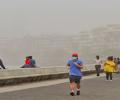
'Till such time climatic activities resume up north in the plains and the hills, Mumbai's air quality may not improve.'

Sometimes I run past a house where the owner has died. The children are abroad. The doors and windows are closed. That is the case with thousands of homes across Kerala.

The Dyson Pure Hot + Cool is expensive but worth the price. It clearly differentiates itself from similar machines in both looks and performance, says Khalid Anzar.

The PM2.5 level (presence in the air of particles with a diametre of less than 2.5 micrometres) touched a new high at 158 as authorities predicted further deterioration of air quality in the coming days.

The 24-metre-high air purifier recorded a PM2.5 concentration of 642 micrograms per cubic metre at the inlet and 453 micrograms per cubic metre at the outlet.

The maximum temperature on Saturday settled at 18.1 degrees Celsius, two notches below the season's average, and the minimum was recorded at 3.6 degrees Celsius, four notches below the season's average, the IMD said.

The city's air quality index will fluctuate between the higher end of the "poor" category and the lower end of the "very poor" category, it predicted.

With such announcements grabbing the voters' attention, critical issues like pollution, especially the smog that chokes Delhi every winter, remain largely unaddressed. Many residents have raised concerns over the lack of concrete action plans to combat air pollution, which continues to pose a severe health risk to Delhiites.
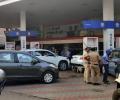
The Delhi government has announced that vehicles older than 15 years will be denied fuel at petrol pumps starting April 1.

There will be a blanket ban on the production, sale and use of all types of firecrackers in the national capital, including on Diwali, till January 1, 2023, Environment Minister Gopal Rai said on Wednesday.

Delhi Chief Minister Arvind Kejriwal announced that primary schools will be closed from Saturday in view of spike in pollution levels in the national capital.

According to Central Pollution Control Board's (CPCB) Sameer app, the city's air quality index (AQI) stood at 449 in the severe category at 8 am on Saturday. It was 462 on Friday.

A division bench of Chief Justice D K Upadhyaya and Justice G S Kulkarni said while it was not going to order a ban on bursting of firecrackers, a balance needs to be struck considering the deteriorating air quality index (AQI) in the metropolis.

Despite legal deterrent in place to discourage people from doing so, by dusk, residents in many neighborhoods, including some areas in south Delhi and northwest Delhi, had started bursting crackers.

For Swara Bhaskar, this Diwali has brought multiple joys.

After churning across the Arabian Sea for more than 10 days, Biparjoy made landfall near Jakhau Port in Gujarat on Thursday.

Delhi will become the first such city in India to have such a scheme and the only one after Beijing in Asia.

Uncertainty looms over Lanka-Bangla World Cup clash due to severe air pollution
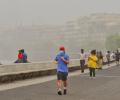
La Nina, construction worsen air quality; spike in respiratory ailments.

The Delhi government has banned construction and demolition activities in the city till November 21.

The rains could lead to a rise in the water levels of the Yamuna, which has been flowing above the danger mark of 205.33 metres for days now.

Keeping up his tradition of celebrating the festival with soldiers, Prime Minister Narendra Modi visited Sir Creek near the Indo-Pak border in Gujarat's Kutch district and offered sweets to jawans.

Production, storage and sale of firecrackers in the capital will be punishable with a fine of up to Rs 5,000 and three years jail under Section 9B of the Explosives Act, the minister told a press conference in New Delhi.
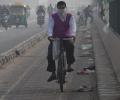
With seasonal crop residue burning, coupled with vehicle emissions, calm winds and low temperatures persisting for some time, the thick layer of toxic smog has hovered over the national capital.
This is the third time this season, after December 8 and January 1, that visibility has dropped to zero metres in the city.

People living in the national capital and in states such as Maharashtra, Uttar Pradesh, Madhya Pradesh and Tamil Nadu are more likely to contract COVID-19 due to prolonged exposure to high concentration of PM 2.5, according to a new pan-India study.

Once called India's garden city, this upper middle-class residential area in Bangalore has India's most toxic air, says Devanik Saha, IndiaSpend.com.
